I Only Had One Dream
But It Was a Big One: To Write.

Last fall, I decided that my fiftieth year would be the Year of Writing. As a teenager with no safety net, I never imagined this possibility. My father had died. My mother struggled with mental illness. As recent immigrants, I had only my younger brother, and $200 to my name, and barely enough English to get by. But I had stories, even if I didn't yet have the voice to tell them.
I did what was necessary. I cleaned houses. I bussed tables. I stumbled through high school one shift and one dictionary lookup at a time. (How Google Translate would have transformed my life back then!)
An elderly woman whose house I cleaned loved my stories. She'd invite me over to tend to her cat and listen as I shared tales about Iran and my life beyond her walls. One day she sat me down and told me about a college offering scholarships "to students like me."
"Like what?" I asked.
"Those who have interesting stories." she said, handing me paper and a pen. I didn't know how to type yet. She corrected my spelling mistakes before I submitted my application, handwritten in awkward, broken English. I got in. Full ride. I still feel the warmth of gratitude when I think of her.
I chose to study French literature—not because it was practical, but because I wanted to read Victor Hugo and Alexandre Dumas in their original language. I learned French and English simultaneously while working four jobs, always making time for the cat and the elderly woman, covering everything the scholarship didn't: books, food, bus fare. I was constantly exhausted, but finally close to what I'd always wanted—to write, to think, to belong.
When I graduated, reality came rushing back. I couldn't afford to work for free for a year or two, ruling out publishing. Writing jobs paid even less. So I found my way into marketing, storytelling's shinier, more capitalist cousin. It paid the bills. I found a place to live. Eventually, bought an apartment, then a house. I got married. I had a child. I adopted another. Got a dog. I built a life.
But the dream never left.
I love the act of writing now that I've finally made space for it. I've been surprised by how deeply the words affect me when they're my own. The publishing world, however, doesn't exactly throw parades for debut authors at midlife. We're told it's too late, that we missed our chance—not in actual words of course, that would be politically incorrect, but the numbers tell the story. Industry data suggests authors in their 30s receive the most publishing contracts for first books. I know better. Because I'm not the writer I would've been at 20. I'm better.
I know how to survive now. How to listen. How to wait for a sentence to emerge, and how to honor it when it does. I love the ritual of sitting down each morning with my coffee, watching the blank page transform. I love letting myself slow down, taking time with each paragraph, giving my thoughts the attention they deserve.
So yes, I'm a debut author at 50. And no, I'm not sorry for the wait. Because everything I've lived is now something I can write.
I've discovered some lifetime favorites that immediately went onto my reading list: Hijas Olvidadas and Los Gritos de las Gaviotas by Reyes Vargas, a breakout author from Seville who didn't publish her first novel until she was 50. Now she's leading a renaissance in Spanish crime fiction.
And one more encouraging thing. Forget what you've heard about declining readership. Spain is experiencing a literary explosion. With over 77 million books sold in 2024 and projections even higher for 2025, reading is booming. Over two-thirds of Spaniards read for pleasure, with young people surprisingly leading the charge.
Crime fiction—novela negra—stands at the center of this resurgence. Once dismissed as cheap thrillers, these stories now function as cultural X-rays, probing Spain's darker truths with clarity and precision. The new wave of noir concerns itself less with whodunits and more with why they did it—and what that reveals about society.
From Courtroom to Bestseller List
Vargas fuses courtroom expertise with literary depth. A lawyer with a doctorate in criminal law, she didn't just imagine the justice system—she lived in it. When she traded legal briefs for fiction, she brought that lived-in authority with her.
Her first two novels made waves across Andalucía, establishing her as the region's noir queen. Now, with Feria de Sombras—releasing tomorrow from Penguin Random House—she's poised to take the national stage.
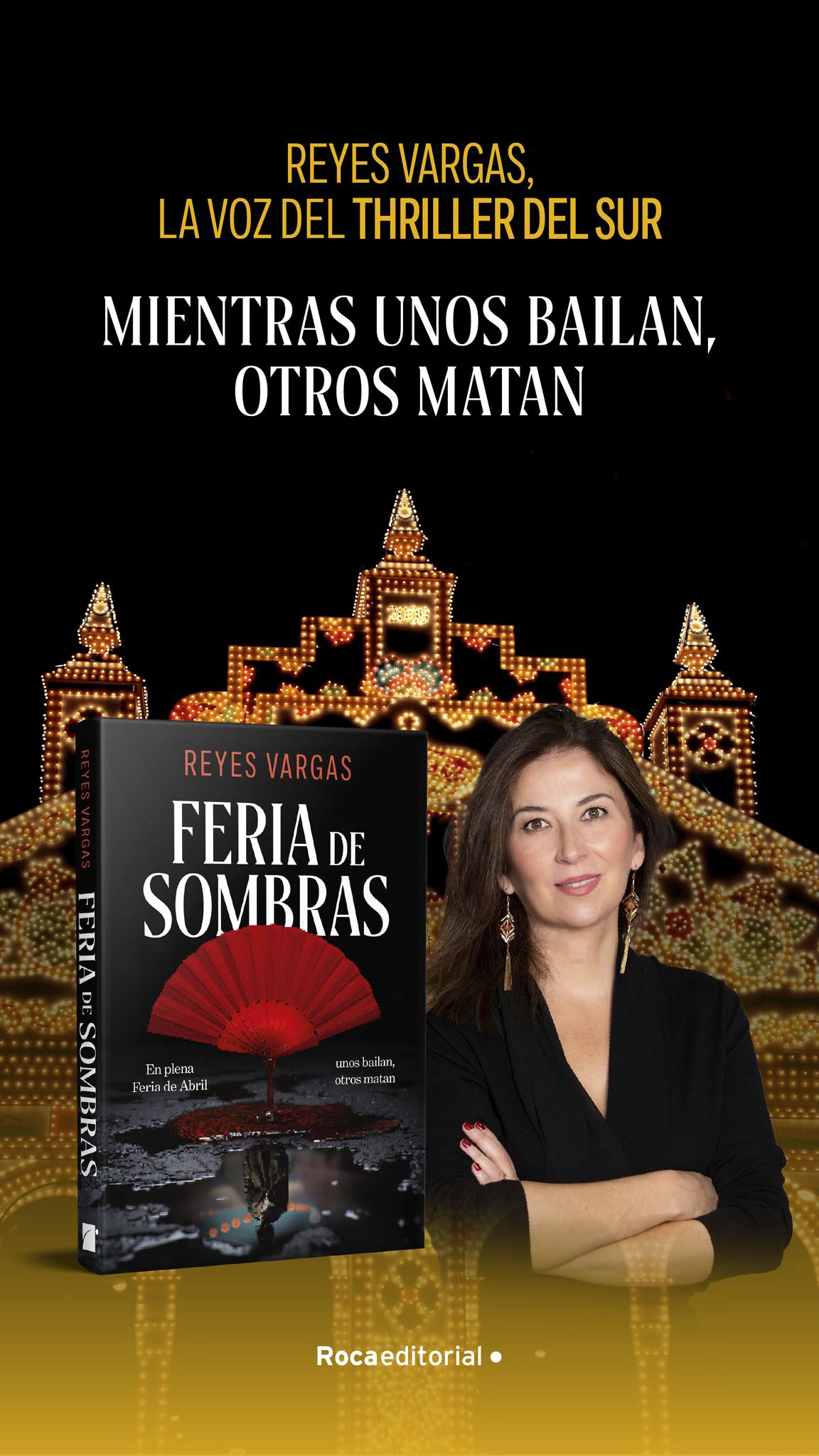
Set during Seville's legendary spring fair, Feria de Sombras peels back layers of sequins and flamenco to reveal something far grittier: the hidden violence and psychological unraveling beneath the party lights. It's part thriller, part social commentary, and entirely addictive.
For Vargas, music is the muse. "Characters materialize when the rhythm aligns," she says. You can feel it in her writing. Her prose carries the pulse of flamenco and the ache of fado—rhythmic, deliberate, and emotionally charged.
If you ever needed an excuse to come to Spain—or simply need a mental escape—don’t miss out on Feria de Sombras. Let Vargas guide you through Seville's sunlit plazas and shadowed alleyways, where past dances with present, and secrets beg to be unearthed.
Even better? Meet Reyes Vargas in person at the Encuentro Literario Letras en Off on May 13 in Seville, where she'll be signing books and sharing her journey from courtroom to publishing house.
Because here's the truth: stories don't expire. Neither do storytellers. Whether you're 15 or 50, it's never too late to start writing. Or reading. Or fighting for your place in the narrative. And Reyes Vargas is living proof.
Hope to see you all there.

What a lovely post, Layla! I love how you weave in your own story and pivot to promote someone else’s story and how you take inspiration from her.
Looking forward to reading your book when it comes out!
This is so beautiful; thank you so much for sharing! I’m grateful for all the amazing ways you choose to take challenges and turn them to beauty that we can all benefit by. Will you be writing more to help guide us to finding ways we can do the same?